
Sequoyah County Court Records After Arrest
Court records after a jail arrest follow a different path than the sheriff roster. An arrest creates a booking record at the Sequoyah County Jail / Sequoyah County Justice Center. Reports then move to the Sequoyah County District Attorney's Office, where the prosecutor decides what charges to file, amend, reject, or dismiss. The filed case is maintained by the Sequoyah County Court Clerk as part of the District Court record.
The jail charge and the court charge can differ. A roster entry may use the arresting officer's label, a warrant label, or a bond-revocation label. The court record is the better source for filed charge language, case number, hearings, bond orders, dispositions, and later sealing or expungement activity. Current custody and booking details belong with Sequoyah County jail inmate records, while booking photos are handled through Sequoyah County jail mugshots.
Find Sequoyah County Court Records
The official court-record path begins with statewide Oklahoma court portals and the Sequoyah County Court Clerk. The OSCN docket search supports searches by case number, party, lower-court case number, and traffic citation. The ODCR portal is also named by the Sequoyah County Court Clerk payment page for online public court records and payments in participating courts. If a new case is not visible online, the clerk may have the most current filing status.
- Start with the jail roster only to capture name spelling, booking date, booking number, inmate ID, and booking charge text.
- Search OSCN by party name, and select the relevant court or county when that option is available.
- Search by case number if the jail, bondsman, attorney, or Court Clerk has provided one.
- Check ODCR for public court records and payment functions in participating courts.
- Call or visit the Court Clerk if the case is new, older, sealed, juvenile, or not showing online.
- Use OSBI CHIRP only when the need is a statewide criminal-history request rather than one court docket.
The Oklahoma State Courts Network search screen is shown at the official OSCN docket search.
OSCN is useful for searching filed court records after an arrest, but very new or restricted matters may require clerk contact.
Sequoyah Court Search Fields
OSCN and ODCR do not work like the jail roster. The court portals search filed case records, not current custody. A person can be in jail before the district court case appears online, and a jail booking can show one charge label while the prosecutor later files different or amended counts. Use the case number when possible because it is more precise than a name search.
| Portal | Field Label | Type | Required | Notes |
|---|---|---|---|---|
| OSCN | Court Selection | Dropdown or list | Yes for targeted search | Select the relevant court or county when available. |
| OSCN | Search by Case Number | Text | No | Best when a case number has been provided by the clerk, attorney, jail, or bondsman. |
| OSCN | Search by Party | Text | No | Use the defendant's name as it appears in the jail or court record. |
| OSCN | Lower Court Case Number | Text | No | Used for appellate-related searching rather than ordinary jail booking checks. |
| OSCN | Traffic Citation | Text | No | Useful for district court traffic matters. |
| ODCR | Court group | Dropdown | No | Visible options include All Courts, Oklahoma District Courts, and Tribal Courts. |
Sequoyah County Court Offices
The official county offices list identifies Melanie Edgmon as Court Clerk and Jack Thorp as District Attorney. The Court Clerk records, files, and maintains permanent records of District Court proceedings, including appearance, plaintiff and defendant, and journal dockets. The District Attorney is the prosecutor for state criminal charges filed after an arrest in Sequoyah County District Court. The clerk's record is the filing trail. The prosecutor's decision controls what charges are filed or changed.
Sequoyah County Court Clerk
120 E. Chickasaw Ave., Suite 205
Sallisaw, OK 74955
(918) 775-4411
Sequoyah County District Attorney
120 E. Chickasaw Ave., Suite 204
Sallisaw, OK 74955
(918) 775-9131
The Court Clerk's official description appears on the county Court Clerk page.
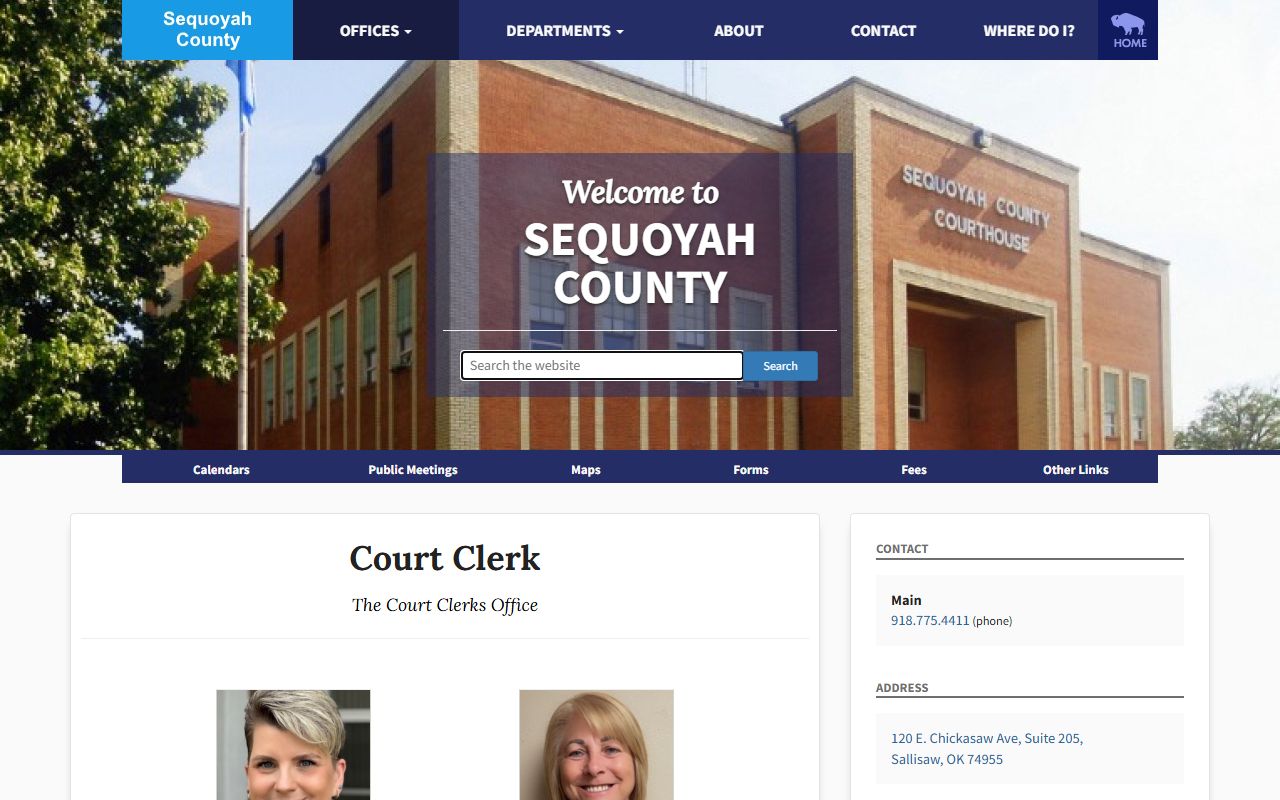
That office is the local source when an online court search does not show a new, old, sealed, or restricted case record.
Charging Documents After Arrest
After a Sequoyah County arrest, the booking record may exist before a formal case is filed. The prosecutor reviews reports and decides whether the court case should begin with a charging document. In Oklahoma criminal practice, common charging paths include a complaint, an information, or an indictment. The exact document depends on the case type and procedural path. Serious felony cases may involve additional felony procedures, hearings, or later amended filings.
| Document | Filed By | Common Use | Why It Matters |
|---|---|---|---|
| Complaint | Officer or prosecutor | Often used to start a criminal case. | May be the first filed accusation after the jail arrest. |
| Information | Prosecutor | Common formal filing for many state charges. | States the charge the District Attorney chooses to prosecute. |
| Indictment | Grand jury | Used in serious or grand-jury matters. | Begins prosecution through a grand-jury charging decision. |
Sequoyah Charge Status Terms
Charge status tells where the filed charge stands in court. It is not the same thing as the charge label on a jail profile. A filed charge can be pending, amended, reduced, dismissed, or resolved by plea or verdict. A bond revocation can return a person to custody even when the new issue is about release status rather than a fresh offense. Court status should be checked count by count because one case can contain multiple charges with different outcomes.
| Status | What It Means | Custody Impact |
|---|---|---|
| Pending | The charge has been filed and has not reached final disposition. | Bond, holds, or court orders decide whether the person remains in jail. |
| Amended | The prosecutor or court changed the charge wording, level, or count. | The jail roster may still show earlier booking text. |
| Reduced | The charge level or offense was lowered. | Bond or sentencing exposure may change, but custody must be confirmed. |
| Dismissed | The charge ended without conviction. | Other charges, warrants, or holds can still block release. |
| Nolle prosequi | The prosecution declined to proceed on that charge. | Similar to dismissal for custody review, but other counts may remain. |
| Conviction | A plea or finding resulted in guilt. | Sentence, jail credit, probation, or state transfer may follow. |
Note: A charge is an accusation until a court disposition creates a conviction or another final outcome.
Bond and Warrant Pathway
Bond begins as a release issue and often becomes a court-record issue once a case is filed. Sequoyah County's official bondsmen page warns that bonds not filled in or notarized properly will not be accepted, approved, or filed by the Court Clerk's Office. It also says bonds must include case numbers if cases have already been filed. That local rule connects the jail roster to court records: use the roster for custody and booking charge text, then confirm the filed case number before relying on bond paperwork.
No dedicated Sequoyah County active-warrant database was located on the official sheriff page. The official Most Wanted page invites tips, and the sheriff app advertises wanted persons. Warrants can also appear in court dockets as failure-to-appear entries, bench warrants, recall or quash orders, bond revocations, or hold entries. If a warrant has already led to a booking, the jail roster should show the person while in custody.
| Issue | Where to Check | Sequoyah County Detail |
|---|---|---|
| Cash or surety bond | Jail first, then Court Clerk after filing | Call the jail for current posting instructions; use the Court Clerk for filed case number and court payment questions. |
| PR or own recognizance | Court docket or clerk | Release depends on a judge's order and court conditions. |
| No-bond hold | Jail, court, or agency that placed the hold | May arise from warrant, revocation, detainer, probation, parole, federal, or ICE issues. |
| Bench warrant | OSCN, ODCR, Court Clerk | Often tied to failure to appear or court noncompliance. |
| Most Wanted tip | Sheriff Most Wanted or app | Dispatch/non-emergency line is (918) 775-9155 for tips listed by the sheriff. |
Charges Versus Convictions
Sequoyah County court records after an arrest may show accusations long before any conviction exists. A filed charge means the prosecutor has accused the defendant in court. A conviction means guilt was established by plea, verdict, or other qualifying disposition. This distinction is vital when reading jail records, court dockets, bond entries, and statewide background material. A dismissed charge should not be described as a conviction.
| Point | Charge | Conviction |
|---|---|---|
| Stage | Accusation filed or listed in court. | Final or qualifying finding of guilt. |
| Proof level | Can begin from probable cause and prosecutor filing. | Requires plea, verdict, or accepted disposition. |
| Roster match | May differ from the jail booking charge. | Does not come from the roster alone. |
| Public record | Often public unless sealed, juvenile, expunged, or restricted. | Often public unless sealed, expunged, or otherwise restricted. |
| Use caution | Should be described as alleged or pending unless resolved. | Should be checked against the final docket entry. |
Sealed and Expunged Records
Oklahoma open-record law supports access to many public records, but it also recognizes limits. Juvenile records, sealed records, expunged records, victim-sensitive material, ongoing investigations, medical information, and court-restricted documents can be withheld or redacted. Oklahoma expungement sources point to 22 O.S. §§ 18 and 19 for eligible expungements and sealing procedure. OSBI explains that Section 18 can expunge an entire arrest record, while a 991(c) deferred sentence changes the disposition after completion but does not remove the arrest record itself.
| Point | Sealed | Expunged |
|---|---|---|
| Public visibility | Hidden from ordinary public access by court order. | Removed or treated as unavailable under the expungement order. |
| Legal basis | Often tied to a court restriction, juvenile rule, or sealing statute. | Requires eligibility and court process under Oklahoma expungement law. |
| Agency action | Agency limits public release according to the order. | Agency updates or restricts records according to the expungement order. |
| Practical step | Ask the Court Clerk whether the public record is sealed. | Use the final expungement order when contacting the originating agency. |
Sequoyah Court Access Limits
The Oklahoma Open Records Act, including 51 O.S. §§ 24A.1-24A.30 and law-enforcement record provisions in 51 O.S. § 24A.8, supports public access to many government records. That does not make every arrest-related record public in every form. Court records can be restricted by sealing, expungement, juvenile confidentiality, victim-protection rules, and case-specific court orders. Law-enforcement records can be limited by ongoing-investigation rules or other exemptions.
The OSBI CHIRP portal is separate from a court docket search. It is used for statewide criminal-history requests, while OSCN and ODCR are used to look up specific court cases. Background checks for employment, housing, credit, insurance, tenant screening, or similar regulated decisions require a legally compliant consumer-reporting process. Casual court lookup and jail roster review should not be used as a substitute for that process.
Important: A court charge, a jail booking, and a conviction are three different records; verify each with the office that created it.